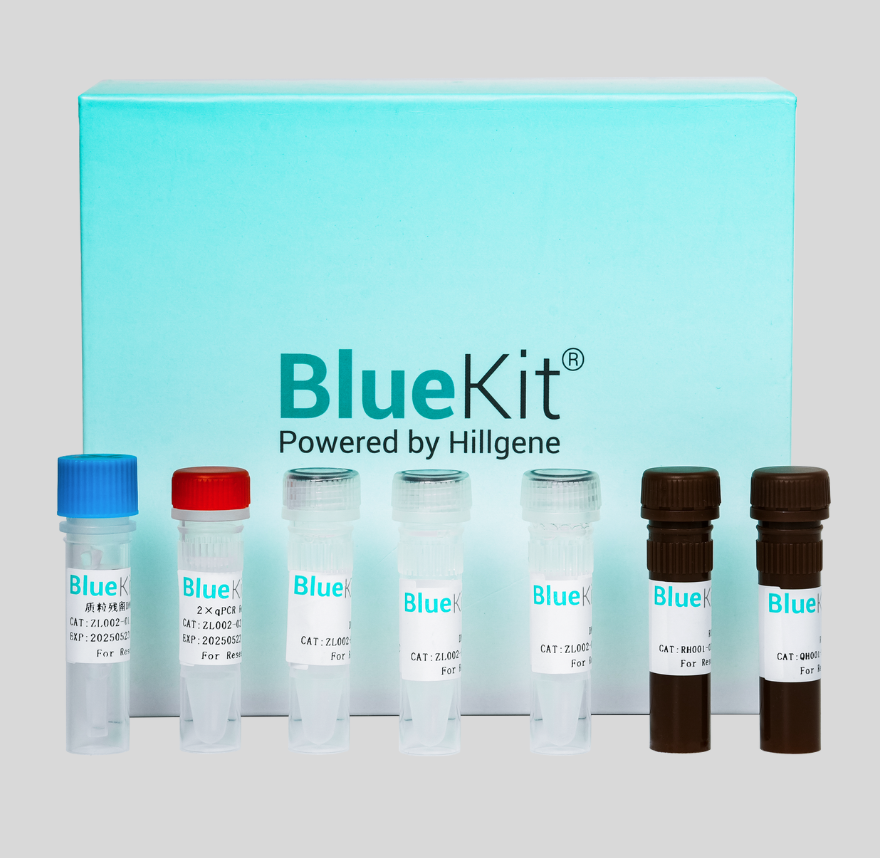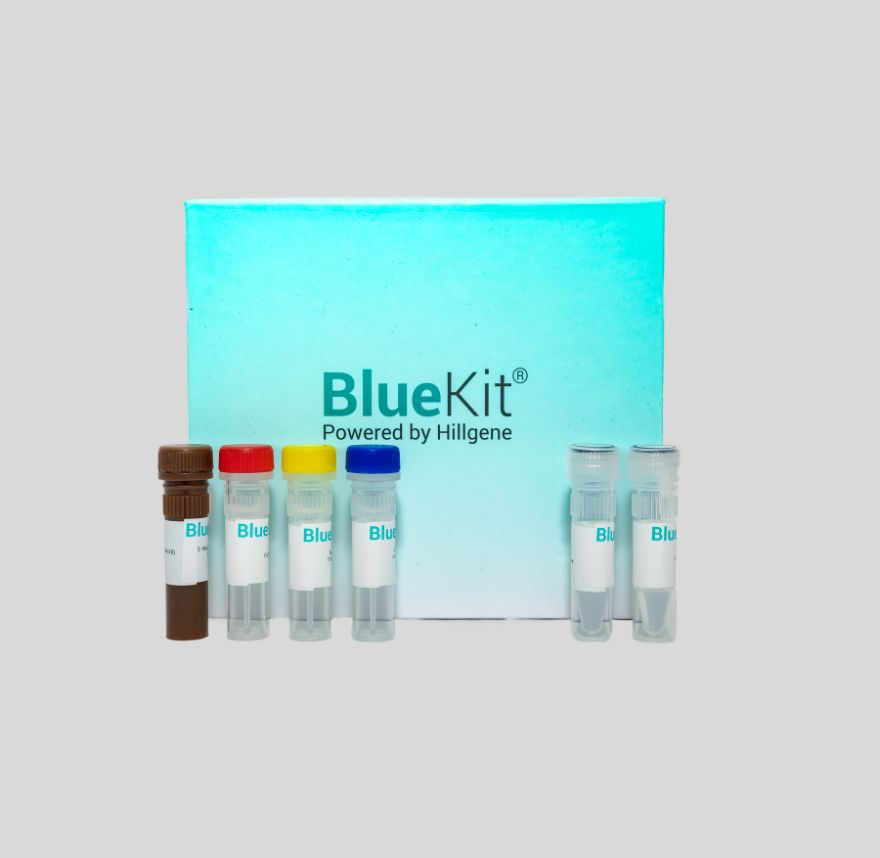
The Bluekit Pichia Residual DNA Detection Kit (qPCR) is designed for quantitative detection of residual host cell DNA from Pichia pastoris in biological products, drug intermediates, semi-finished and finished products.
This kit utilizes TaqMan probe-based qPCR technology, offering rapid detection, high specificity and reliable performance with sensitivity down to femtogram levels.
Clinical-Grade Sensitivity: qPCR-based detection with validated 3 fg/μL sensitivity for residual DNA quantification.
Regulatory-Compliant: Meets USP/EP/ChP standards for biologics quality control (≤10 ng/dose).
GMP-Ready Solution: Pre-validated kit with full documentation for pharmaceutical QC applications.
1. Sample Preparation
Input Material: Purified biologics (vaccines, therapeutic proteins, etc.) or process intermediates.
DNA Extraction: Use a validated method (e.g., column-based or magnetic bead extraction) to isolate residual DNA.
Elution: Resuspend DNA in nuclease-free water or TE buffer (10–50 µL).
2. qPCR Setup (Using HG-PD001 Kit)
Reaction Mix:
Prepare master mix containing:
qPCR buffer (with dNTPs, Mg²⁺, stabilizers)
Pichia-specific primers/probe (included)
DNA polymerase (hot-start, high-fidelity)
Internal control (optional, for inhibition monitoring)
Standards: Run a 5-point standard curve (e.g., 10 ng/µL – 3 fg/µL) in duplicate.
Samples/Loading: Add 2–5 µL of extracted DNA per well (96-well plate format).
3. qPCR Run
Cycling Conditions (Typical):
Initial Denaturation: 95°C, 2 min
40 Cycles: 95°C (15 sec) → 60°C (1 min, fluorescence read)
Platform: Compatible with major real-time PCR systems (e.g., ABI 7500, Roche LightCycler®).
4. Data Analysis
Quantification: Calculate DNA concentration (fg/µL) from the standard curve (R² ≥ 0.98).
Acceptance Criteria:
Negative Control: No amplification (Cq > 40).
Positive Control: Cq within ±1 cycle of expected value.
Sample CV: ≤25% for replicates.
Reporting: Compare results to pharmacopeial limits (e.g., ≤10 ng/dose).
5. Documentation & Compliance
Records: Document all steps per ALCOA+ principles (GMP).
Validation: Include system suitability, LOD/LOQ, and precision data in reports.
1.Immunogenic Reactions
Exogenous DNA may be recognized by the human immune system as “non-self,” and certain components may activate the innate immune system, leading to inflammatory responses or the production of neutralizing antibodies (which could affect drug efficacy). The risk level depends on the amount of residual DNA, fragment size, route of administration (e.g., intravenous injection poses a higher risk than oral administration), and the patient’s immune status.
2.Carcinogenic or Insertional Mutagenesis Risk
Residual DNA containing active gene fragments (such as proto-oncogenes) could theoretically integrate randomly into the host genome, leading to mutations (this requires stringent conditions such as sufficiently large DNA fragments, transformation activity, and host cells being in a division phase). Although the probability is low, regulatory agencies mandate “as much removal as possible.”
3.Regulatory Compliance Failure
Organizations such as the WHO, FDA, and EMA impose strict limits on the amount of residual exogenous DNA in biopharmaceutical products, typically ≤10 ng/dose. Failure to meet these standards can result in clinical trial suspension, product recalls, or rejection of marketing applications.
Purpose:
Accurate detection of trace Pichia pastoris host residual DNA (down to fg-level), ensuring compliance with global pharmacopeial limits (e.g., ≤10 ng/dose).
Feature:
Sensitivity as low as 3 fg/μL, meeting stringent regulations (e.g., EMA’s ≤10 pg/dose for vaccines).
qPCR technology: Sole method recommended by ChP 2020/USP, with sequence-specificity and accuracy.
Technical Effort:
Validated by ICH experts, aligning with FDA/EMA/ChP standards.
Rigorous QC: Linear standard curve (R²≥0.98), amplification efficiency (85–110%), spike recovery (50–150%).
Application:
Lot release testing (e.g., HPV vaccines, insulin), purification process optimization, end-to-end production QC.
Purpose:
Mitigate risks of immunogenicity, insertional mutagenesis, and non-compliance caused by DNA residues.
Feature:
Covers global limits: ChP (≤10 ng/dose for fungi), FDA (≤100 pg/dose), EP (≤10 pg/dose for vaccines).
Risk-adaptive design: Supports risk assessment for varied administration routes (IV/oral) and patient immunogenicity.
Technical Effort:
Targets high-risk fragments (e.g., proto-oncogenes) to reduce mutagenesis potential.
Delivers validation packages for WHO/FDA/EMA submissions.
Application:
Clinical trial applications, marketing authorization (e.g., mAbs/cytokines), cross-border tech transfer (leveraging EU QP certification).
Purpose:
Break international monopolies with cost-effective, all-scenario solutions for complex biologics.
Feature:
Proprietary platform: Developed on PuXin’s HiCellx® QC platform, performance rivals global competitors.
Multi-scenario compatibility: Supports P. pastoris-expressed products (hormones, vaccines, blood products, cytokines, enzymes).
Technical Effort:
Stable GMP-grade kit supply for advanced therapies (CAR-T, stem cells).
Global testing services (via EU HQ and FDA DMF-filed plasmids).
Application:
Bioprocess development (e.g., chromatography/nuclease validation), CDMO manufacturing (MAH system), global multicenter clinical sample testing.
Application Scenario
A vaccine manufacturer required QC testing for residual P. pastoris DNA in commercial HPV vaccine batches to comply with EP standards (≤10 pg/dose).
Technical Challenge
Detecting ultra-trace DNA (≤10 pg/dose) in complex vaccine matrices with high protein/lipid interference.
Solution Implemented
Used HG-PD001 kit with optimized lysis buffer for inhibitor-resistant DNA extraction.
Performed triplicate qPCR (ABI 7500) targeting AOX1 gene (yeast-specific).
Included spike recovery controls (10 pg/μL) and NTC/NCS validation.
Outcome & Validation Data
Achieved LOD: 3 fg/μL (S/N >3.5).
All 20 batches passed EP limit (≤0.01 ng/μL residual DNA).
Inter-assay CV: 3.8% (n=24).
Recovery rate: 92–108% (across operators).
Application Scenario
A biotech company needed to validate DNA clearance efficiency during recombinant insulin downstream purification (chromatography + nuclease treatment).
Technical Challenge
Quantifying fragmented DNA post-digestion (<100 bp) amid nuclease/enzyme residues that inhibit PCR.
Solution Implemented
Deployed HG-PD001 with heat-denaturation step to inactivate nucleases.
Used SYBR Green qPCR with shortened amplicons (75 bp) for fragmented DNA.
Ran spike-in ERC (50 fg/μL) at each purification step.
Outcome & Validation Data
Confirmed >99.5% DNA clearance post-purification (vs. 85% pre-optimization).
Linearity: R²=0.996 (1–10⁴ fg/μL).
Detection of 25-bp fragments (LOD: 5 fg/μL).
Met ChP limit: ≤10 ng/dose in final product.
Application Scenario
A CDMO performing safety assessment for EU-approved CAR-T therapy (produced in P. pastoris) needed to validate absence of DNA in viral vectors.
Technical Challenge
Detecting host DNA in lentiviral vector preparations with high viscosity and carrier DNA background.
Solution Implemented
Automated extraction (QIAcube) + HG-PD001 kit with DNase pretreatment to remove carrier DNA.
TaqMan probe-based qPCR (Roche LightCycler 480) for specificity.
Validated against FDA/EMA guidelines for gene therapies.
Outcome & Validation Data
Residual DNA ≤0.1 pg/vector dose (below FDA threshold of 100 pg/dose).
Zero false positives in 30+ clinical batches.
Received EU QP certification for lot release.
CV: <5% (inter-operator variability).

 86 13381666596
  info@hillgene.com
 English