A lentiviral vector CDMO is a specialized partner that develops, manufactures, and tests lentiviral vectors under GMP-ready quality systems so cell therapy companies can move from discovery into IND/CTA-enabling work, clinical trials, and commercialization with less risk and faster timelines. In cell therapy manufacturing, the vector is often a true “make-or-break” material—so choosing the right CDMO can directly impact transduction performance, consistency, and regulatory success.
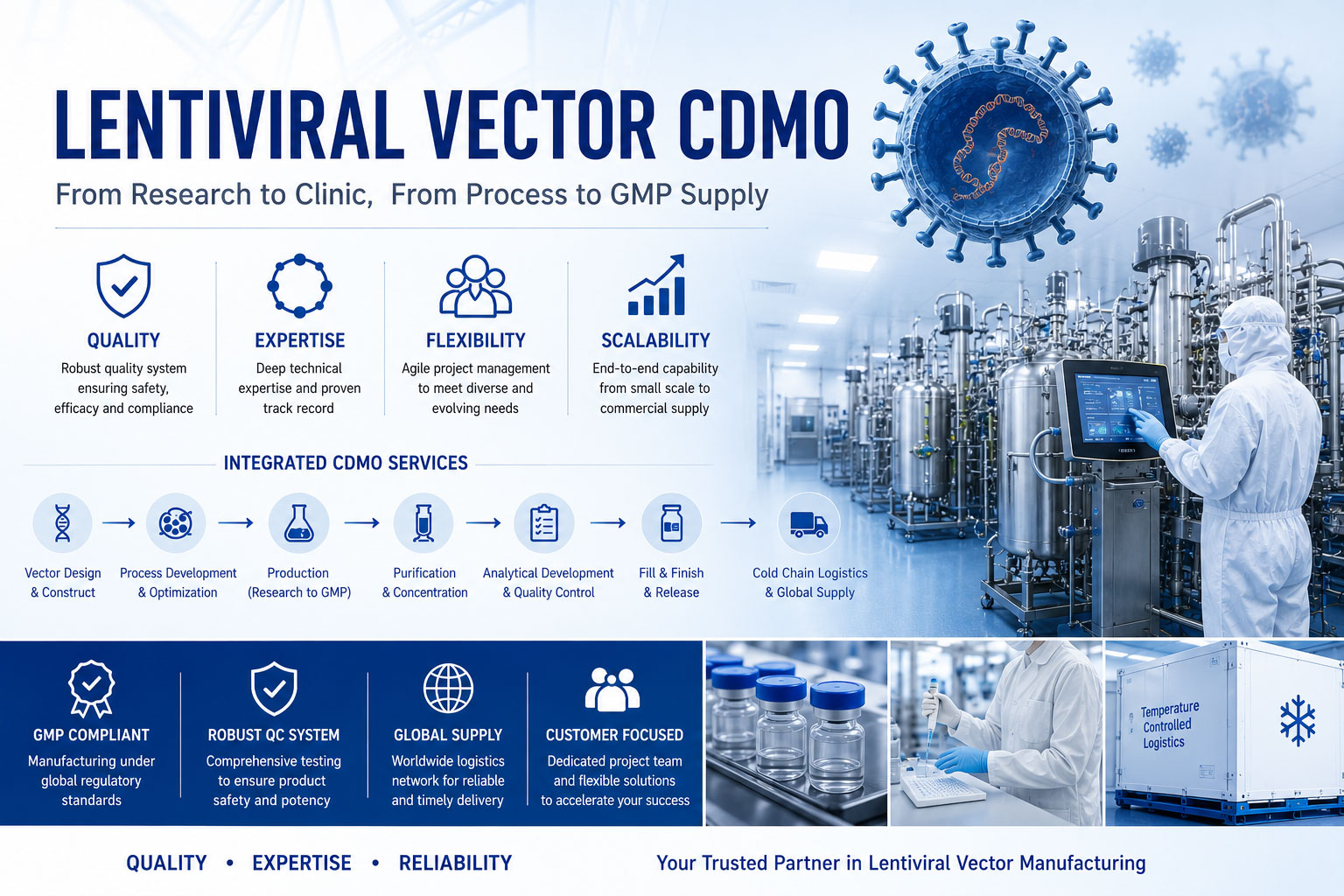
Lentiviral vectors are complex biologics used to deliver genetic payloads into immune cells and stem cells for CAR-T, CAR-NK, TCR-T, and HSC gene therapies. A capable lentiviral vector cdmo typically provides:
Vector design support and construct readiness for manufacturing
Plasmid strategy and supply (often the first bottleneck)
Upstream production (adherent or suspension) and downstream purification
In-process controls, batch record execution, and GMP documentation
Release and characterization testing aligned to clinical stage needs
CMC and regulatory support (including DMF strategies where applicable)
When sponsors search for lentiviral vector cdmo services, they’re usually trying to solve a full chain of problems: “How do we achieve reliable titer and transduction, hit timeline targets, and generate a release package regulators will accept?”
For many programs, lentiviral vector performance influences the entire drug product process. If vector quality fluctuates, teams may see higher MOI requirements, inconsistent positivity rates, or difficulty controlling vector copy number (VCN)—all of which can create cost, comparability, and regulatory challenges.
A specialized CDMO matters because it helps you control the critical outcomes that translate into patient doses:
Titer and yield (can you produce enough TU to meet demand?)
Transduction efficiency (can you reach target positivity with practical MOI?)
VCN control (can you stay within spec while maintaining potency?)
Consistency (can you reproduce performance batch to batch?)
Speed and predictability (can you hit the clinic without repeated rework?)
End-to-end support isn’t a slogan—it’s an operational advantage. For example, Jiangsu Hillgene is headquartered in Suzhou and operates a 10,000㎡ GMP facility and R&D center, with manufacturing sites in Shenzhen, Shanghai, Belgium, and the USA. The practical benefit of this kind of footprint is not just capacity, but integrated systems that reduce handoffs between vendors.A strong end-to-end model usually includes integrated platforms such as:
Nucleic acid manufacturing (to secure plasmid supply and shorten the critical path)
Serum-free suspension culturing (to support scalable production strategies)
Closed-process automation (to reduce contamination risk and variability)
Advanced QC testing capabilities (to speed release and strengthen data integrity)
Hillgene’s platform highlights include a self-adapted third-generation quad plasmid vector system (supporting traditional VSV-G and novel envelopes), serum-free 293T suspension technology in disposable bioreactors, and a scale range from 10L up to 100L with reported yield up to 2E11 TU/50L—capabilities that map closely to what many cell therapy teams need when moving from early clinical demand to larger supply planning.
Vector performance can be constrained by plasmid quality, system design, and insert characteristics. Third-generation systems (including quad plasmid approaches) can support safety expectations while enabling robust manufacturing—especially when paired with a well-controlled plasmid supply chain.
The shift to serum-free suspension 293T platforms and disposable bioreactors is often driven by scalability, operational efficiency, and consistency. But success depends on more than equipment—it requires a process that holds performance as volume increases and a QC strategy that can keep up with output.
Teams increasingly want to achieve high positivity at lower MOI while maintaining low copy number in the final cell product. Platform data that examines different GOI lengths and their impact on harvest titer and transduction outcomes can be especially valuable during process development and risk assessment.
When selecting lentiviral vector cdmo services, focus on what will affect your program’s risk and speed:
Evidence of success across different insert sizes, envelopes, and target cell types
A clear plan for platform selection (adherent vs suspension) and scale-up pathway
QC depth: potency-related analytics, impurity testing, and viral safety strategy
Mature quality systems plus “execution muscle” (deviations, CAPA, change control)
Regulatory readiness, including DMF support where relevant (Hillgene notes a completed DMF filing)
A lentiviral vector cdmo is not just a supplier—it’s a development partner that can shape manufacturability, clinical readiness, and long-term scalability for cell therapy programs. With the right CDMO, sponsors can reduce technical risk, accelerate timelines, and build a vector strategy that remains viable from first-in-human through commercialization.
What are lentiviral vector CDMO services typically used for?
They’re used to develop and manufacture lentiviral vectors for programs like CAR-T, CAR-NK, TCR-T, and HSC gene therapy, including process development, GMP production, QC release testing, and CMC support.
When should a biotech engage a lentiviral vector CDMO?
Many teams engage a CDMO before IND/CTA-enabling studies so process development, analytical strategy, and documentation are aligned with clinical requirements early—reducing rework later.
What’s the difference between research-grade and GMP lentiviral vectors?
GMP vectors are manufactured under controlled quality systems with full documentation, defined raw materials, validated/qualified methods where appropriate, and release testing suitable for clinical use.
Why do insert size and GOI length matter in lentivirus manufacturing?
Large inserts can reduce packaging efficiency and lower titer, which may force higher MOI or additional concentration steps. This is why process optimization and platform data for different GOI lengths can be critical.
How do CDMOs support regulatory submissions for lentiviral vectors?
They provide CMC documentation, batch records, QC results, and supporting method information. Some CDMOs also maintain DMFs and can provide a letter of authorization to streamline sponsor filings.
 86 13381666596
  info@hillgene.com
 English
.webp "Industry Insight | Breakthrough in NK Cell Expansion: Novel K562 Feeder Line Enhances Yield and Purity")