Suspension and adherent lentivirus production are two proven manufacturing approaches, and CDMOs choose between them based on your required dose demand, timeline, cost targets, facility fit, and the risk of process changes later in development. In general, adherent platforms can be fast to start for early-stage needs, while serum-free suspension systems are often preferred for scalable, commercial-leaning supply—especially when you need consistent performance from 10L up to 100L and beyond.
For cell and gene therapy programs, lentiviral vector is not just an input—it frequently determines transduction performance, manufacturing throughput, and ultimately how many patient doses you can supply per batch. Platform choice affects:
How quickly you can get to engineering and GMP runs
Batch-to-batch consistency and comparability strategy
Scale-up feasibility as demand grows
Cost per dose and operational complexity
Regulatory confidence in process control and reproducibility. That’s why experienced CDMOs treat platform selection as an early, high-impact decision within Lentiviral Vector CDMO Services, not a last-minute manufacturing preference.
Adherent production commonly uses 293T cells grown on surfaces (e.g., cell stacks, multilayer flasks, fixed-bed systems). Many labs begin here because it aligns with R&D workflows and can generate vector quickly for early proof-of-concept work.
Fast early ramp when the process already exists in-house
Familiar workflow for many discovery teams
Can be suitable for small clinical demand or early-stage programs
Straightforward small-scale troubleshooting (hands-on visibility)
Scaling is labor- and space-intensive, especially with multilayer vessels
Higher risk of variability from manual handling and complex logistics
Increased operational burden for closed processing and contamination control
More difficult to support very large campaigns without major footprint expansion
For many sponsors, adherent production is an “early bridge.” The risk is that if demand increases, you may need a platform switch—triggering comparability work, documentation updates, and potential timeline impact.
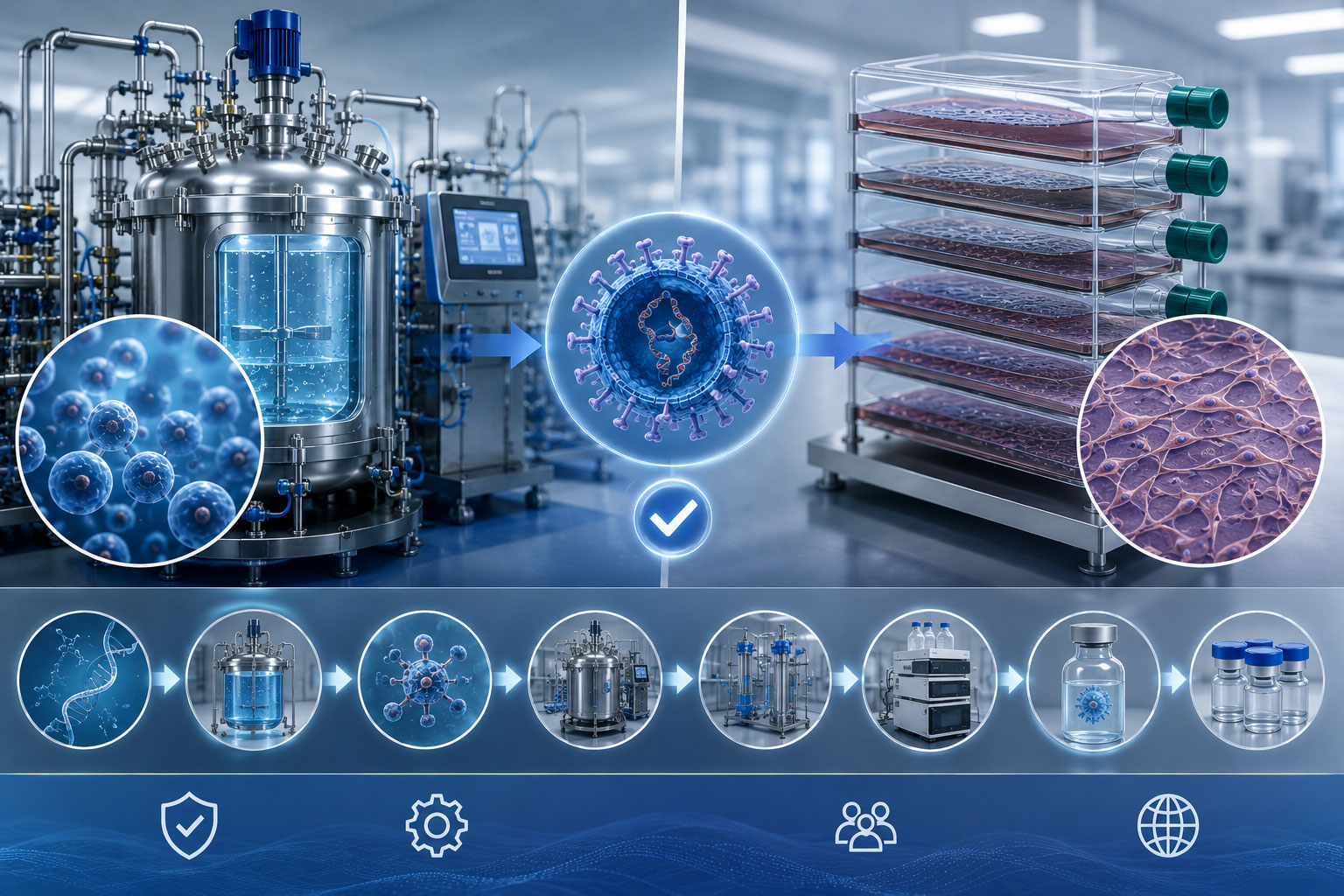
Suspension production grows cells in the liquid phase, typically in stirred-tank or rocking single-use bioreactors. This format is popular because it supports more predictable scale-up, streamlined operations, and reduced dependence on large surface areas.Hillgene, for example, highlights a serum-free suspension 293T platform (“Virus Expressed 293T serum-free culture technology”) with disposable bioreactors, with reported scale from 10L to 100L and yield up to 2E11 TU/50L—an example of why many CDMOs and sponsors favor suspension for programs that need headroom.
Scalable volumes (often a clearer path from 10L to 100L)
Serum-free systems can simplify raw material controls and consistency
Operationally compatible with single-use bioreactors
Often better aligned with closed processing and automation
More efficient for campaigns supporting multiple clinical sites or larger cohorts
Requires platform know-how (media, feeding, mixing, transfection conditions)
Process development may be needed if you’re migrating from adherent
Upstream and downstream conditions must be tuned to preserve infectivity and yield
A strong Lentiviral Vector CDMO should be able to explain not only that they “run suspension,” but how they control the key variables that maintain titer and transduction performance at scale.
Below are the decision factors CDMOs use when recommending adherent vs suspension within lentiviral vector cdmo services.
If you need vector quickly for early feasibility or a near-term milestone, a CDMO may suggest staying with your current platform to avoid rework. If you’re heading into multi-site clinical trials or planning for scale, a suspension pathway may be recommended earlier to reduce later disruption.
The real question is: how much total transducing units (TU) do you need, and how often? Programs supporting hundreds of patients may benefit from suspension production to avoid running many small adherent batches.
Large inserts can reduce packaging efficiency and lower titer. CDMOs consider whether your construct will behave differently across platforms and what optimization work is realistic. This is where platform data and experience across GOI lengths becomes valuable.
CAR-T, CAR-NK, TCR-T, UCAR-T, and gene-edited HSC programs often have different transduction sensitivities. Some programs require higher titer or specific envelopes (e.g., VSV-G or alternatives such as BaEV) to achieve target positivity and acceptable VCN. CDMOs factor this into both upstream output needs and overall vector strategy.
Manufacturing is only as fast as the slowest step. CDMOs evaluate:
Whether the facility supports closed or automated processing
Whether downstream purification is compatible with the selected scale
Whether QC testing capacity matches batch frequency and release timelines
Hillgene’s integrated setup—nucleic acid manufacturing, serum-free suspension culturing, closed-process development, and advanced QC testing—reflects the kind of “system-level” readiness that makes suspension platforms easier to execute at scale.
Switching platforms mid-development can trigger comparability requirements and additional documentation. CDMOs weigh:
The likelihood of a future platform change
The availability of bridging strategies and characterization data
The sponsor’s regulatory pathway (regions, agencies, timelines)
If you need a fast decision, here’s a sponsor-friendly way to think about it:
Choose adherent when: you need small quantities quickly, you already have a working adherent process, and near-term speed matters more than long-term scale economics.
Choose suspension when: you need scalable supply, want a clearer path to commercial readiness, prefer serum-free systems, and want to minimize later platform changes.
For many teams, the best strategy is a staged plan: get early clinical material using the fastest viable route, while initiating suspension development in parallel if future demand is likely.
For sponsors evaluating a CDMO partner, capabilities that reduce platform risk are often decisive. Hillgene positions its lentiviral vector offering as end-to-end lentiviral vector cdmo services, including:
A third-generation quad plasmid vector system
Traditional VSV-G and novel envelope options
Completed DMF filing support
Serum-free suspension 293T production in disposable bioreactors
Scale from 10L to 100L, targeting high yield and process consistency
Experience supporting CAR-T, CAR-NK, TCR-T, UCAR-T, gene-edited HSCs, and iPS-derived programs
Suspension vs adherent production isn’t a debate about which is “better”—it’s a decision about what best fits your program’s stage, supply needs, and risk tolerance. The right Lentiviral Vector CDMO will recommend a platform based on your dose demand, construct complexity, transduction goals, and regulatory path, then back it up with data, execution experience, and a scalable quality system.
Is suspension lentivirus production always better than adherent?
No. Suspension is often more scalable, but adherent can be faster to start for early-stage needs. The best platform depends on demand, timeline, and your long-term manufacturing strategy.
When should I switch from adherent to suspension lentivirus manufacturing?
Ideally before demand outgrows adherent capacity—often around the transition from early clinical to later-stage trials. Switching earlier can reduce comparability risk later, but it requires development time.
How do CDMOs estimate which platform I need?
They model total TU demand, batch frequency, target titer, downstream recovery, and QC timelines—then match that to facility fit and scalability requirements.
Do different envelopes (like VSV-G vs BaEV) affect platform choice?
They can. Envelope choice impacts tropism and transduction performance in different cell types, which can change your required titer and therefore influence upstream platform and scale decisions.
What should I ask a lentiviral vector CDMO before choosing a platform?
Ask about demonstrated scale ranges, typical titers and recovery, contamination and deviation history, QC release turnaround, comparability strategy, and how they support regulatory documentation (including DMF options).
 86 13381666596
  info@hillgene.com
 English