China’s Cell and Gene Therapy (CGT) industry continued its rapid expansion in the first quarter of 2026, remaining one of the most attractive sectors for biotech investment.
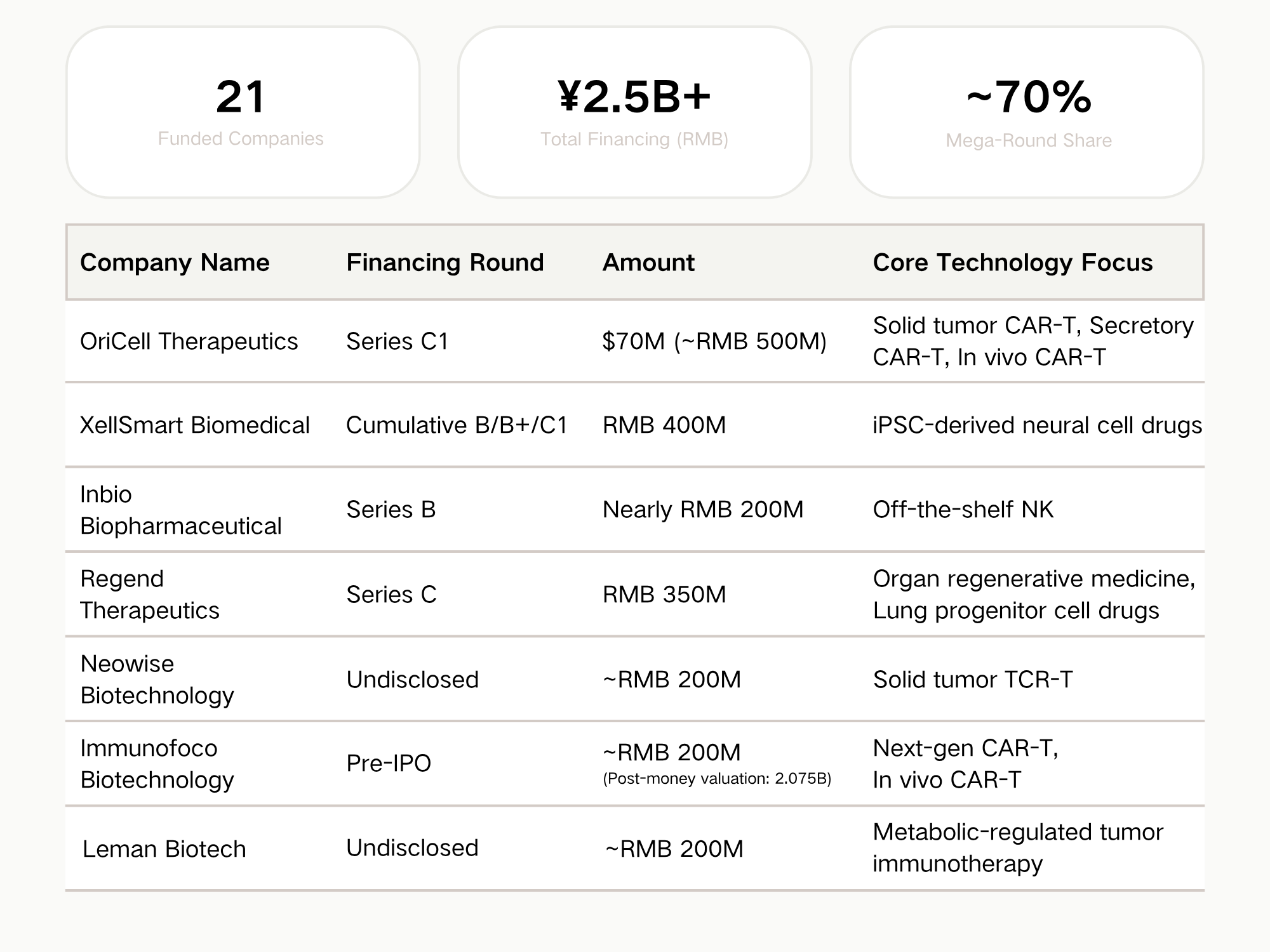
According to publicly disclosed data and industry reports, 21 Chinese CGT companies completed financing rounds between January and March 2026, with total disclosed funding exceeding RMB 2.5 billion. Nearly 70% of the financing rounds surpassed RMB 100 million, spanning multiple therapeutic modalities including CAR-T, TCR-T, NK cell therapy, iPSC, regenerative medicine, and in vivo gene editing.
Industry observers believe the current financing wave reflects China’s CGT sector entering a new stage of clinical advancement and commercialization readiness.
Among the most notable financing events, Origincell Therapeutics completed a USD 70 million C1 financing round focused on solid tumor CAR-T, secreted CAR-T, and in vivo CAR-T technologies. XiZE Bio raised a cumulative RMB 400 million to advance iPSC-derived neural cell therapies, while InBeria secured nearly RMB 200 million to support off-the-shelf NK cell therapy development.
Meanwhile, Genemab Bio completed a RMB 350 million C-round financing focused on lung progenitor cell therapeutics and regenerative medicine. NeoInsight Bio, ImmuPeak, and Leman Bio each secured financing rounds valued at approximately RMB 200 million, supporting programs in solid tumor TCR-T, next-generation CAR-T, and metabolism-enhanced immunotherapy, respectively.
Beyond oncology-focused therapies, investment activity also expanded into regenerative medicine and emerging applications. Companies such as AIKAI Bio, Xuelong Bio, Guoke Mingyao, Jingtong Life, and Eshine Bio completed financing rounds across areas including iPSC + AI, ex vivo platelet regeneration, pet stem cell therapeutics, regenerative anti-aging, and islet cell therapies.
From a financing-stage perspective, late-stage rounds increased significantly in Q1 2026. Approximately one-quarter of the financed companies were in C-round or Pre-IPO stages, suggesting that several leading Chinese CGT companies are approaching commercialization milestones.
At the same time, early-stage financing remained highly active in frontier areas such as neurological disease cell therapies, regenerative medicine, and anti-aging technologies, helping establish long-term innovation pipelines for the industry.

Photo by Mufid Majnun on Unsplash
Industry analysts highlighted four major trends emerging from the latest financing cycle.
First, the CGT sector has demonstrated strong resilience amid broader biotech market corrections. While global biopharma financing remains relatively cautious, China’s CGT industry continues to attract sustained investment due to strong long-term market confidence.
Second, financing activity is becoming increasingly diversified across technology platforms. Compared with previous years when CAR-T dominated investment flows, Q1 2026 saw broader investor interest in iPSC, TCR-T, NK, regenerative medicine, and gene editing technologies.
Third, leading Chinese CGT companies are accelerating their entry into public capital markets. Companies such as ImmuPeak have already initiated IPO-related processes, signaling a transition from technology validation toward commercialization-driven competition.
Finally, emerging applications are continuously expanding the boundaries of CGT technologies. Investment in areas such as pet stem cell therapeutics, regenerative anti-aging, and tissue regeneration indicates that CGT applications are rapidly extending beyond traditional oncology and rare disease markets.
With continued clinical progress, evolving regulatory frameworks, and strengthening commercialization capabilities, China’s CGT industry is widely expected to enter a new stage of accelerated growth in the coming years.
Photo by Testalize.me on Unsplash
 86 13381666596
  info@hillgene.com
 English

![Hillgene Was Awarded the TOP 10 Most Promising CXO Companies of [China Biopharmaceutical Industry in 2022]](/uploads/image/20250530/hillgene-was-awarded-the-top-10-most-promising-cxo-companies-of-china-biopharmaceutical-industry-in-2022.webp "Hillgene Was Awarded the TOP 10 Most Promising CXO Companies of [China Biopharmaceutical Industry in 2022]")